The modes of convergent adaptation
What limits the speed of adaptation in a changing world? A key constraint is the underlying genetic architecture – the number of required genetic changes and their individual effects across environments. This architecture determines whether populations can maintain sufficient standing variation and incorporate new mutations fast enough to avoid extinction. By quantifying how standing variation, gene flow, and new mutation each contribute to rapid adaptation, we look to unravel this overarching question.
The origins of resistance via gene amplification
Harbouring cross-resistance to up to six classes of herbicides, the invasion of common waterhemp in agricultural environments is becoming increasingly problematic for crop productivity. With the weedy-agricultural waterhemp variety (Amaranthus tuberculatus var. rudis) having a range historically limited to the South-midwestern United States, first reports of waterhemp occurring in agricultural fields in Ontario, Canada have signalled the need to better understand the relative importance of the spread of resistant, weedy species, compared to the rapid adaptation of what were once benign populations (in this case, Amaranthus tuberculatus var. tuberculatus).
To this end, our work published in PNAS investigates how newly problematic agricultural populations arise, and how the spread of the species relates to the adaptive origins of glyphosate resistance. To dissect this question, we produced the first high quality reference genome for the species, characterized resistance and sequenced whole genomes from numerous populations spanning the epicentre of the agricultural invasion to much more recently established weed populations in Canada. We found that while for the most part, ancestry in these populations varied as expected with geography across the described range of the two subspecies, that populations in two key agricultural regions in Ontario, Walpole Island & Essex County, had drastically different evolutionary origins. Common Waterhemp individuals in Essex County appeared to be a collection of agricultural genotypes from the Midwestern United States—likely introduced through a seed dispersal event—while individuals in Walpole island much more closely resembled nearby natural populations.

Graphic of the spread of glyphosate resistant common waterhemp,
credit: Chris Saskia, Arts & Science News, University of Toronto
The repeatability and spread of single nucleotide target-site resistance
Polygenic architectures and complex gene-amplifications are two very charismatic genetic underpinnings of herbicide resistance. Yet, even for the best studied genetic mechanism of herbicide resistance—simple single nucleotide polymorphisms—found to occur across hundreds of weed species, it remains unclear how often such mutations arise repeatedly within a single species; how long such mutations stick around in populations; the role of gene flow in their spread across the landscape; and how variable signatures of selection are across origins.
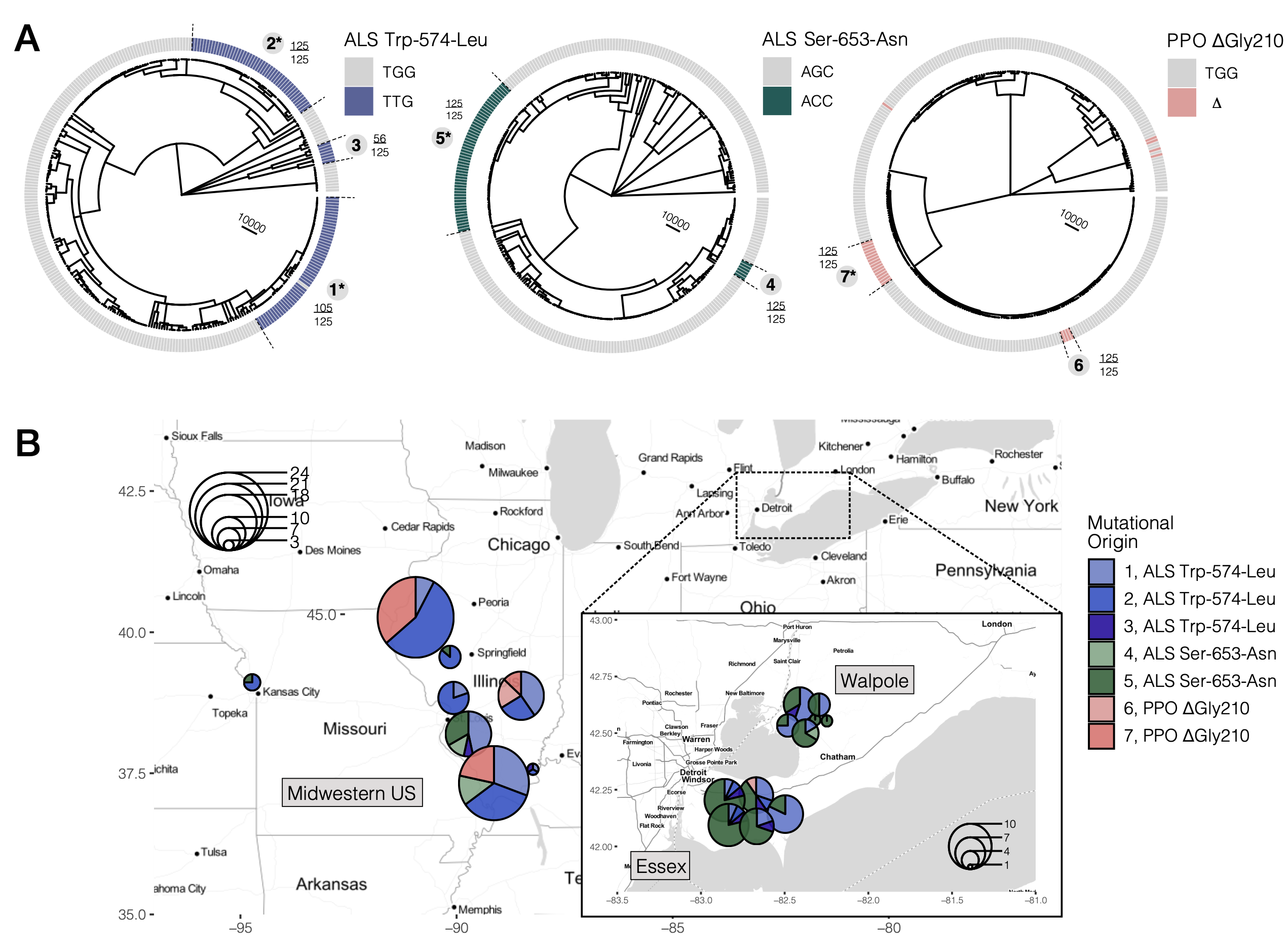
In a paper recently published in eLife, I characterized the repeatability of herbicide resistance evolution, using an increasingly tractable approach in population genomics, tree-sequence reconstruction, that takes into account not just the history of mutation but recombination. Not only did I find parallel evolution of herbicide resistance through changes at 11 distinct amino acids, but this tree reconstruction approach illuminates that 3 of these most common mutations themselves had arisen 7 times (A). By mapping these mutational origins back to the populations each lineage occurs in (B), I was able to decipher a key role of gene flow in the spread of resistance… nearly all mutational origins map to many populations, and most populations contain many mutational origins! Most of these mutational origins occurred after the onset of herbicide use, suggesting that variation for herbicide resistance is young and their persistence depends on herbicide use in these environments. Check out the article for more details on the strength of selection, recent population expansions, and the role of allelic interactions in shaping the distribution of resistance mutations across the range.
Relevant Publications
Kreiner JM, Giacomini D, Bemm F, Waithaka B, Regalado J, Lanz C, Hildebrandt J, Sikkema PH, Tranel PJ, Weigel D, Stinchcombe JR, & Wright SI. 2019. Multiple modes of convergent adaptation in the spread of glyphosate-resistant Amaranthus tuberculatus. PNAS. doi: 10.1073/pnas.1900870116
Kreiner JM, Sandler, G., Stern, A.J., Tranel PJ, Weigel D, Stinchcombe JR, & Wright SI. 2022. Repeated origins, gene flow, and allelic interactions of herbicide resistance mutations in a widespread agricultural weed. eLife. doi: https://elifesciences.org/articles/70242
 Kreiner Lab