
Peter & Rosemary Grant, made famous for their 40 years of work on Darwin’s Galapagos finches and the Pulitzer Prize-winning book “The Beak of the Finch”, recently visited the University of Toronto to receive honorary doctorates and speak to us on their search of the causes of evolution. Almost as poetically as the quote from the Jonathan Weiner book –
“Evolution discloses a meaning in death, although the meaning is like some of the berries that Darwin tasted in the Galapagos, “acid & Austere.” There is a special providence in the fall of a sparrow. Even Drought bears fruit. Even death is a seed.”
– Peter & Rosemary walked us through their trials and successes in taking “one family and study(ing) it thoroughly, principally with a view to the theory of the origin of species” – Wallace 1847. In order to study evolution by natural selection though, one must know about the underlying genotype, the manifested phenotype, and fitness based on environment-specific reproduction and survival. And their system has is all. Their familiarity with the finches on Daphne Major, 40 years of sampling and tracking of environmental variables and their effects has allowed them to develop arguably the most thoroughly understood system and insight into the origin of species in evolutionary biology. The classic story of Darwin’s finches that most interested people are probably aware of is the remarkable evolutionary response of beak size and depth to fluctuations in water availability, and thus corresponding food sources in the form of seeds. These phenotypic and environmental variables were the motivation for their studies and development of their research program. In the next few paragraphs I’ll highlight the questions and approaches Peter & Rosemary took during their career and presentation, which should no doubt be “goals” for all of us, aspiring evolutionary biologists.
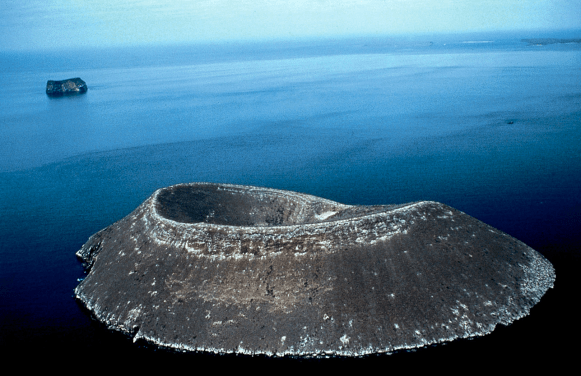
Peter started off the first half the talk, addressing the first component of the evolutionary trio: genotype. The answer to the first question – what is the evolutionary potential of beak depth and length? – is that there is tons! Extremely high levels of heritability, between 0.70 and 0.8 characterize these traits, similar to the heritability of height in humans. Now knowing that these traits are inherited by offspring and that they can evolve over generations, they moved on to investigating the genetic basis of beak size and depth. Two vastly different approaches, developmental bio gene localization and comparative genomics of finch species that differ in beak morphology, allowed them to identify the gene and pathway of interest.
Next up: phenotype. Careful observations and measurements of beak allometry over 40 years allowed for dissecting the morphological response and selective pressure driving these rapid evolutionary changes on ecological time scales. Along with these measurements, tracking patterns of rainfall and drastic shifts in community composition as the result of these shifts between drought, El Niños, and back to drought, provided a spectacular connection between phenotype and environment, and the dynamics of adaptative evolution. Moreover, differences in the response of what were once undifferentiable finch species to extreme selection from drought allowed for tracing back of the evolutionary history and trajectory of these now genetically distinct taxa as a result of character displacement.
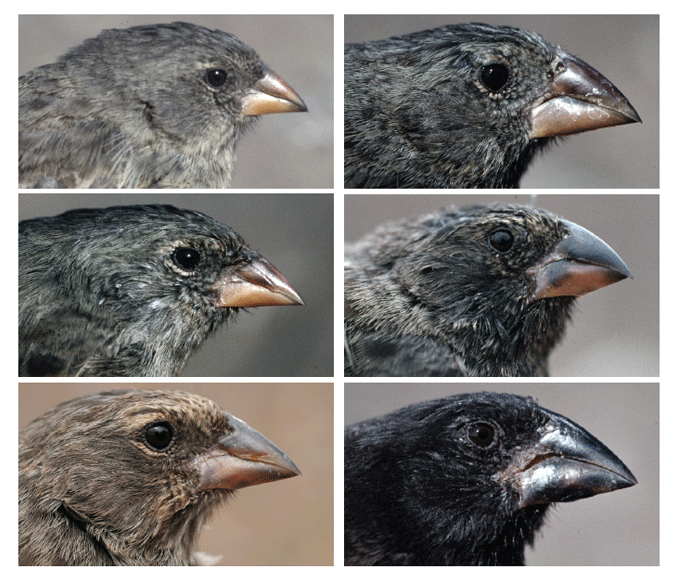
Darwin’s Finches on Daphne Major Island” – P. & R. Grant
And now for the origin of species (as told by Rosemary Grant). We now know that character displacement of beak morphology likely played a key role in the radiation of Darwin’s finches on Daphne Major – but how strong is their divergence? What are the causes and consequences of gene flow between species, and in particular, what is the barrier to reproductive isolation and why does it on occasion, leak? In birds, song and morphology are the two key traits that keep species reproductively isolated. The Grants dissected this hypothesis as any biologist is taught to do; treatments and controls. They manipulated the presence and absence of song & morphology (i.e. recordings and dummy birds) to assess the interest of courting birds with one or the other. They found that hybridization between species occurred between individuals as long as their morphologies were relatively well matched, even despite a mismatched song. These type of hybridizations were rare, only occurring 1 – 2% of the time. Interestingly though, hybrid fitness was nil – offspring never survived to reproduction. After investigation, they found that the lack of hybrid fitness was not due to genetic incompatibilities, but rather niche displacement – birds with intermediately lengthed beaks did poorly under drought conditions. Luck was in their favour, however, as an El Niño in 1982 that brought the rains relaxed selection for long and deep beaks and allowed for their persistence.
But the story doesn’t stop there! In 1982, a novel and tremendously sized ground finch came to the island and managed to establish a highly inbreed breeding population on the island via hybridization with the local species. This new lineage offers exciting prospects for the continued study of the evolutionary trajectory of Darwin’s finches. Occurring in its own separate niche, the Grants ask – is this the origins of a new species? And many other open questions remain. How will inbreeding depression influence the trajectory of the population? Will gene flow prevent its divergence from other local populations and species on the island?
I found their talk extremely inspiring, not just for the thoroughness of their science and integration of an array of approaches from different fields, but their historical insight and outlook on science. Aside from an amazing dynamic between Peter and Rosemary and quite an entertaining question period, they left it off with some words of wisdom that encompasses their outlook, but also one that I felt particularly relevant for my work and the future of evolutionary research in this “omics” era.
Fundamentally, the study of evolution and ecology requires insight into genomics… “but reciprocally, reliable interpretation of genomic data requires an understanding of ecology, evolution, and behavior” – Peter & Rosemary Grant
Cheers!
 Kreiner Lab